
Author: Fred Widarsson
Match CRM data in Salesforce with sales people

Most organizations struggle to match CRM data with the right sales person.
The effort to continuously align your company’s customer data in Salesforce with the right sales people is overwhelming and costly. Most organizations have a lot of customer records owned by the wrong sales person. Many of us have seen what this causes:
- Commissions are paid to the wrong sales people.
- Sales people do not meet their quotas.
- Customers are not being called on by the right people.
- Sales teams can not get a true overview of their customers.
- Mailers are sent out with the wrong sales person’s name listed.
We built RealZips to make it possible for companies to instantly align all their Salesforce CRM data with the right sales person. The current challenge around ownership can within days be turned into an opportunity to drive even greater sales success.
Solving ownership challenges permanently.
Oftentimes, we found ourselves having to align thousands of customer records with the right owner. This challenge turned into the reason for building RealZips. By now, we love hearing the excitement from customers, as they align ownership and set themselves up for sales success. We still find find it amazing to learn how our customers keep all their CRM data aligned over time:

Calculate your risk. Then solve your ownership challenges once and for all.
Calculate how much time your team can save by using our app. Find out how to minimize legal risk for everyone and drive success for your sales team.
Put our ROI Calculator to use.
- Fill in the yellow boxes with your organization’s ballpark values.
- Estimate the risk of revenue being assigned to the wrong person.
- Identify your current risk of commissions being paid out incorrectly.
- Calculate how much time your team can save with RealZips.

When all CRM data in Salesforce is owned by the right person or sales team, both marketing and sales can operate more effectively. The benefits of having CRM data matched with your sales people spans across all internal and external stakeholders.
Can Sales Territory info in Salesforce drive success?

My first job was selling computer systems. I was 19 years old and it was an easy job at first. As more salespeople joined, we had to continuously change sales territories. As the company continued to grow, matters related to sales territories became increasingly complicated.
Being part of a growing sales team, there were many things that kept us awake at night. Are sales territories planned to give us all the same potential? Do other salespeople own customers inside my territory? Am I getting the right commission payout? What are my colleagues’ territory borders?
Ever since my first job, these questions turned out to be similar across most sales teams that grow or change over time. We figured there must be a better way to manage territories.
What if we build an app for Salesforce.com that will
- Use zip codes as the base for sales territories.
- Connect zip codes to all existing CRM data in Salesforce.
- Allow one sales rep or many reps to own each zip code.
- The territory information is then shared across the organization.
Every zip code should be available inside your CRM system. Each zip code should have information related to all sales territory information. Here’s an example of territory information for zip code 10019 in New York:

With the app we built, it is now possible to empower the sales team to drive their success. By making all territory-related information available to everyone in the organization, issues regarding to territory borders becomes a thing of the past. The Salesforce Administrator can add as many salespeople to each zip code as needed, in case your organization operates in for example industry verticals. Resellers, stores and partners can be added to each zip code in the RealZips app.
Sharing territory information for success
When your organization openly shares territory changes, it creates full transparency and reasons to collaborate across the team. The end goal is to connect faster with your customers, which drives success both for customers and your team.
As market conditions change, sales territories must change to better serve customers and balance potential across the territories. Sales territory changes create complexity for the sales team, as territory borders are moved and customers change hands.
By simply tracking all territory changes with full transparency in Salesforce.com, the uncertainty related to territory changes is a thing of the past:
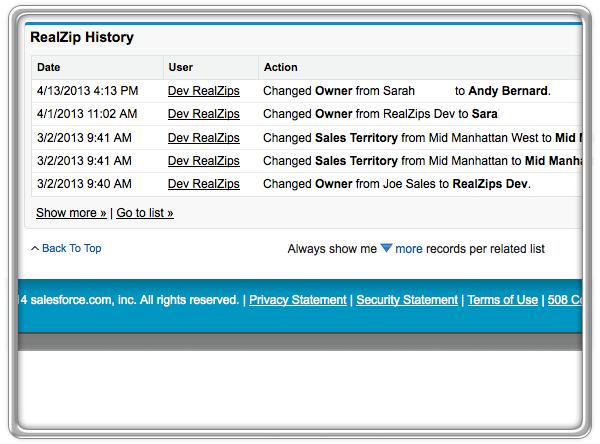
By using our app in your Salesforce CRM system, your team will be empowered to faster connect the right salesperson with the right customer. Uncertainty around sales territories will no longer hold back the team. Instead, everyone has information on sales territories to drive both individual and team sales goals.
Customer feedback
For the team behind the app, it’s a truly exciting journey to help our customers be even more successful. People using RealZips are telling us:
- Everyone can quickly reference the sales team members in every zip code, city, county, metropolitan area, state and sales territory.
- At trade shows we can instantly tell prospects who their sales person is.
- Territory changes can be viewed by everyone, clearing up challenges related to ownership of customers, quota attainment, and commission payouts.
Why enrich CRM data in Salesforce.com?

After 25 years of developing and running CRM systems, every organization we meet has the same question:
The sales and marketing teams can’t find their own data. How do we fix it?
If your team can’t search customers and analyze data, many things happen:
- Duplicate records are added, making it even harder to find data.
- Sales can’t find customers in the CRM system while traveling in the field.
- Marketing can’t effectively target cities, counties or metropolitan areas.
- The team’s trust in your organization’s data goes down.
- Overall usefulness of your CRM data is questioned.
We have witnessed numerous times how this scenario plays out. We kept thinking there must be a better way. What if we added Geographic Data to your CRM data?
What is GeoData?
Geographic Data (GeoData) is geographic data points of many types that enrich your customer data. Samples of GeoData are zip code validation, city and county names, metropolitan areas and time zones. GeoData also adds demographics, federal regions, your organization’s complete sales territory information and more.
Why everyone needs GeoData
Search for “Fort Lauderdale” in your CRM system. Then, try to find all customers in that city by searching for “Ft Lauderdale.” Most likely you won’t find many until you also search for misspellings such as “Ft. Lauderdale” and “Fort Laderdale.”
Next, you want to reach out to customers in towns near Ft. Lauderdale. Include the neighboring town “Hollywood” in your search. Now, your result will likely include customers in many other states:

How GeoData empowers your team
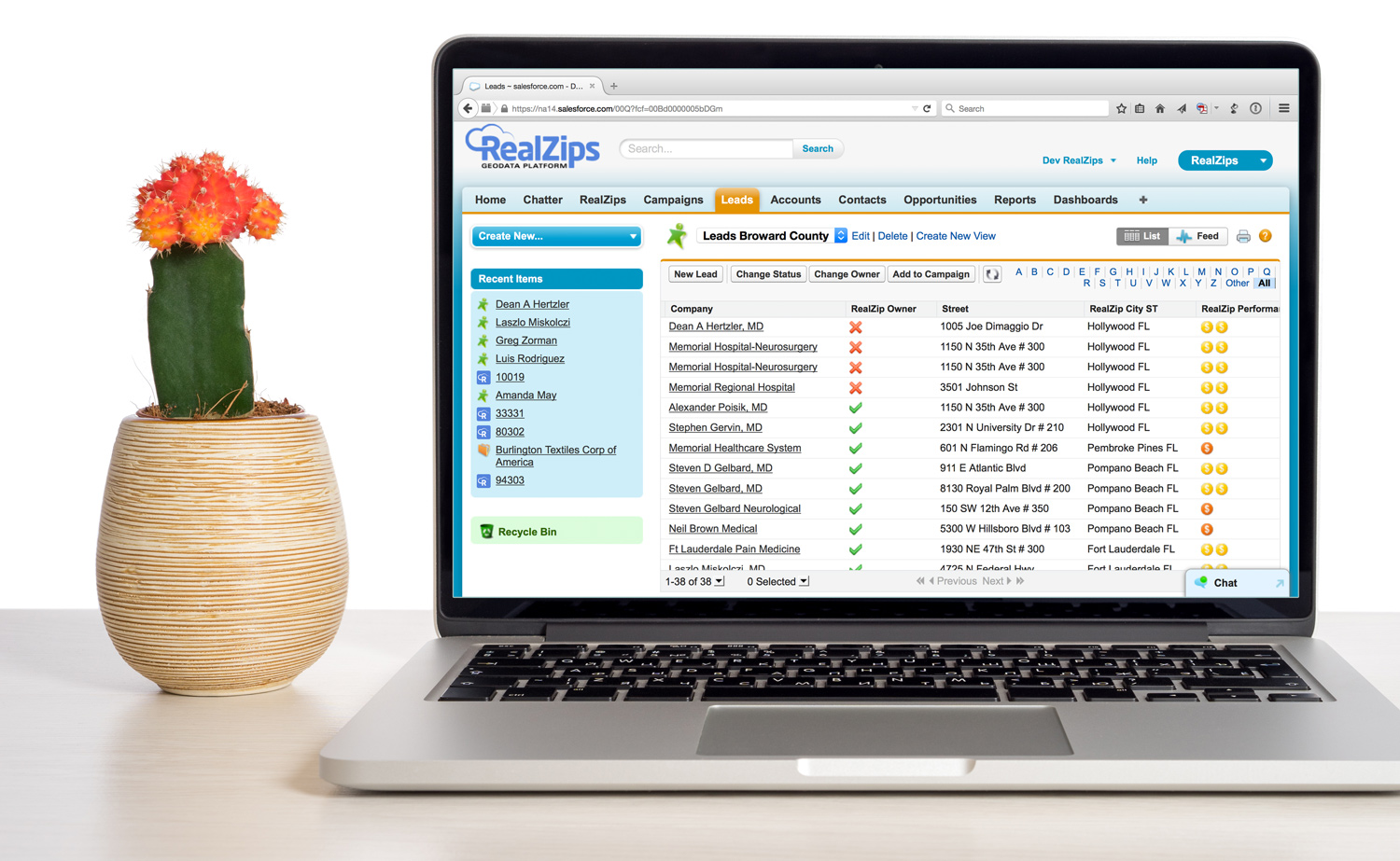
With all your CRM data enriched with GeoData, a search for “Fort Lauderdale” would uncover all the right customers immediately. If you need to include surrounding cities, simply search for the county “Broward FL.”
Within seconds, you can view customers in the cities near Fort Lauderdale:

How GeoData drives sales success
The reasons to enrich CRM Data with GeoData are compelling:
- Adding GeoData is a very quick process, providing a fast ROI.
- Your CRM data will have a robust and useful geographic structure.
- Searches, reporting and analysis will be very powerful for everyone.
Your entire organization will be able to do new things:
- Search customer data across zip codes, cities, counties, metropolitan areas, sales territories, sales regions, time zones and federal regions.
- Match up areas with great business potential against your lead data.
- Your team will gain trust in their CRM data.
GeoData is intended to drive success by identifying and targeting the right customers, which will enable your team to close more deals.
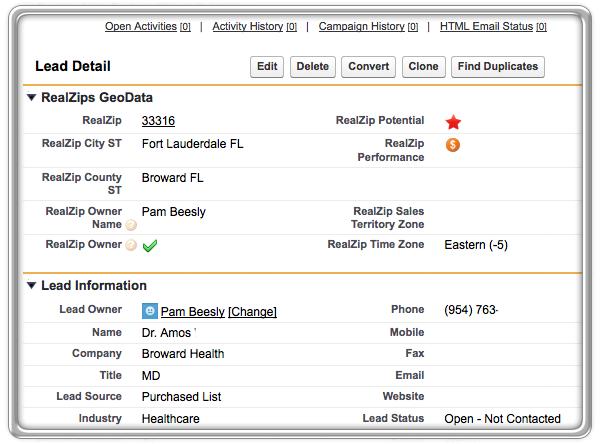
Sample Salesforce Lead record enriched with GeoData
Salesforce records can be enriched with any type of GeoData. In the sample below, a Lead has been enriched with city, county, time zone, owner matching and more:
Hoping this blog helps bring ideas for your team on how to put GeoData to use in Salesforce. Please comment below.
Need to Align Ownership across Salesforce.com?
Having worked with CRM systems for 25 years, the challenge was always the same:
“We must align ownership of customer data, to match up with sales territories”
Aligning ownership is a moving target that’s impossible to keep up with. Sales territory borders change, salespeople get new jobs, not to mention customers moving to new cities.
The effort involved in trying to keep ownership aligned is overwhelming and costly. If your organization does in fact have customer records owned by the wrong salesperson, most of us know what happens:
- Commissions are paid to the wrong sales people.
- Sales people do not meet their quotas.
- Customers are not being called on properly.
- Sales people can’t get a true overview of their own customers.
- Mailers are sent out, with the wrong sales peoples’ names listed.
Seeing all this happen in front of our eyes, we knew there had to be a better way.
Imagine being able to see if a record has the wrong owner:
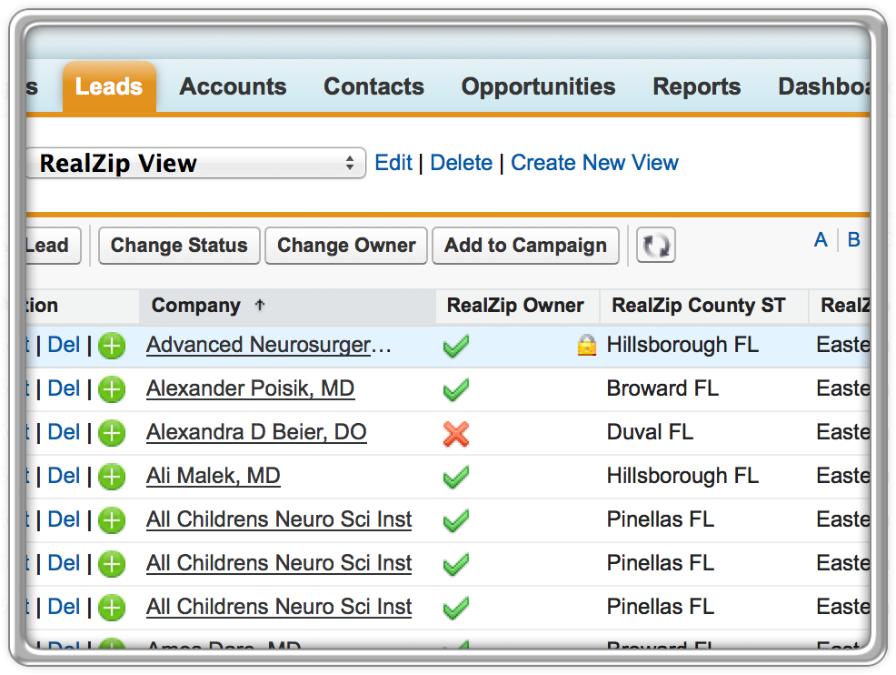
We understood that having capability to align ownership across data in Salesforce.com would have a fundamental impact for most organizations:
- The sales team can immediately spot and correct mistakes.
- The Salesforce Admin is empowered to transfer thousands of records in minutes.
- Your whole team’s trust in your company’s data would improve.
- Your company would be able to connect faster and deeper with customers
Helping teams solve these challenges
After living with these pain-points ourselves for many years, It is now truly exciting to solve these challenges and empower our customers’ entire organizations with our app.
The best part is when our customers call us and letting us know they’re saving 100+ hours in less than 60 minutes. We never get tired of listening to our customers, as they’re telling us how much they love to be able to align ownership across their CRM data.